Trigonometric Functions
I've always used trigonometric functions and I understand their usage but never thought properly about how they're defined and their history so this post is my examination of that. I love maths history and the characters but that tends to focus on European mathematicians and number theory and calculus from the 16th century onwards. While I do enjoy that and there are many fantastic stories and people in that history I should expand and try to discover other stories.
In this post, I'll try to go through the history of trigonometry and the trigonometric functions, their calculations and usages up to modern times. From the tables of painstakingly calculated values in ancient Greece and India to modern computer calculations.
In the beginning, there was a circle...
Of course angles are important, especially since the most basic shapes in triangles and circles require an understanding of the relationship between the angles and lines to be able to fully comprehend. Most cultures would have used angles for two main purposes: construction and astronomy. From what I can tell, most of the trigonometry we know about comes from the Indian and Islamic world which slowly filtered through to Europe with other mathematical inventions via trading routes. There may be other kinds of folk knowledge in various , when constructing structures but it's hard to detail when they're not written down.
The chord is an important geometric construction, being two points on a circle connected by a straight line. The word chord originates from the Latin word chorda meaning cord, indicating that you would construct it by tying a cord across two points on a circle. Some ancient Greeks used this to determine their measurements of the relationships between angles and distances. In this context they defined a chord function which operated on the angle of a chord from the centre of the circle. Ptolemy, who may be most famous for his geocentric model of the Solar System which was promoted by the Catholic Church in opposition to Galileo, created a table of chords so that if you measured the angle of the chord and knew the radius of the circle you could get the length of the chord. See the picture below of how a chord angle works and move the slider to see the angle change as the size of the chord changes.
Ptolemy calculated his table by using some regular polygons to find simple chords such as 36°, 90°, 120°. He also used Ptolemy's Theorem which states that in a quadrilaterial with all the points on the edge of a circle (called an cyclic quadrilateral) the product of the diagonals is equal to the sum of the products of pairs of opposite sides. Drag the vertices around on the below graphic to see how that works. Note that when one of the diagonal lines goes through the centre of the circle that line is the diameter and forms a chord angle with one of the other lines like above.
Circle with radius 50
The details of how to calculate some chords from this are interesting but lengthy so you can check them out here if you want. There's other techniques Ptolemy used to find chords from their angles but I want to pivot to a different question, how would he and others have measured angles? Both practically and what units would they have used?
How big is an angle?
The most natural angle we could imagine is one whole turn of a circle but this feels too large to use in most cases. Therefore the most common system is one devised by the Ancient Babylonians, degrees. This splits a full turn into 360 parts, denoted by the degrees symbol, °. There's multiple possible reasons for this being the way to subdivide a turn but the reason I like the most is that when the triangle between a chord and the centre of a circle is an equilateral triangle, i.e. the length of the line is equal to the radius so all lines are the same length then the angle of a chord is 1/6th of a full turn, and the Babylonians used sexigesimal which is base 60. Our inheritance from that is that we still use minutes and seconds divided into 60s which are convenient since they divide nicely into many different amounts. 6 such chords split into 60 each would give 360 degrees in total.
For measuring angles in the real world, I'm most familiar with protractors which are useful for measuring small angles on paper. In antiquity the main point of measuring angles would've been for astronomy though, in measuring the angle to a star or planet in the sky. To do this you would use inclinometers of different varieties. These could come in many different forms since they're essentially just sticks with markings but one I really like is Jacob's staff which you could use as in the following diagram:
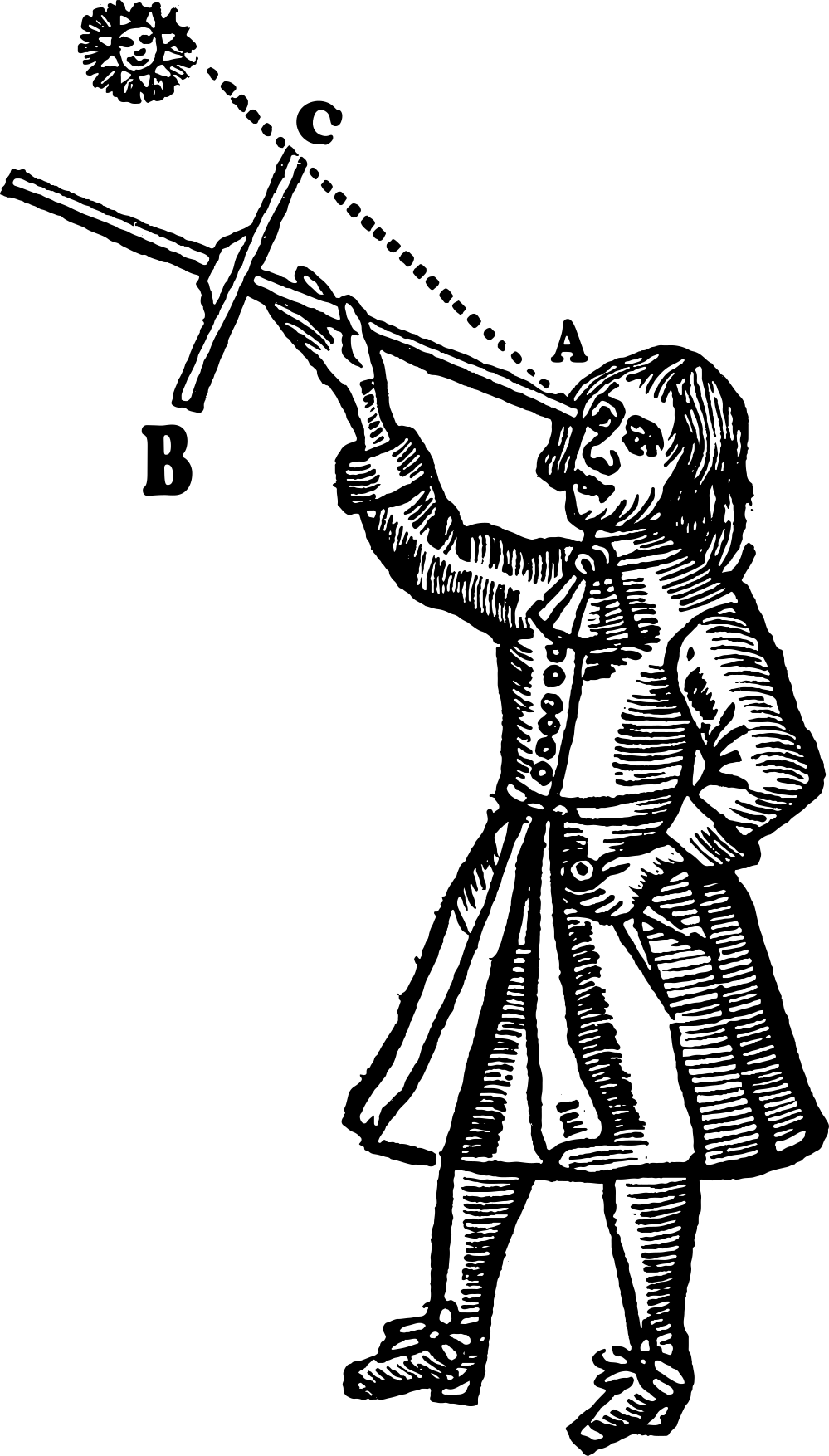

There's a plethora of known instruments and more unknown instruments for measuring angles. There's also other measures of angles such as a more 'metric' angle is the gradian which splits a turn into 400 gons. This has the advantage of making a right angle 100 degrees which is nice since we use base 10 but since it doesn't divide as well, especially into 3, it's not that nice to use so hasn't caught on much. A more important angle measurement is the radian which is a more 'natural' measure and has some useful properties that might make sense later. One radian is defined as the angle when the length of the part of the circle is equal to the radius. See the below diagram for an illustration of an angle of 1 radian.
The Indian Advancements
There were many important changes in the way mathematics was done that originated in India and slowly filtered their way through the Arabic world and to Europe. The most prominant of these is surely the Hindu-Arabic numeral system and as part of that, the digit zero which was so essential for the number system we use today. Pertinent to our needs is the work done on trigonometry though.
They first came up with the definition of the sine function, being half of the chord function, such that . They used the Sanskrit word jyā which means bowstring since the arc of the chord in the circle looks like one. However this was transliterated to Arabic as jayb. This would be okay except that it was translated literally to Latin as sinus, meaning cavity or bosom. This clumsy translation is how we ended up with the name sine for the function. Cosine just comes from the Latin 'complementi sinus', meaning "sine of the complement" while tangent originates from the Latin tangentum meaning touching since it relates to a tangent line which is just touching a curve.
The main 3 trigonometric functions are related to the right-angled triangle such that you can find the ratio between two of the sides from using one of the functions on one of the non right-angled angles. So , , . I learned these by remembering SOHCAHTOA as a short-hand which is strange but it does work. Normally I dislike these kinds of memorisation tactics since they tend to be a substitute for actually learning the principles of what needs to be learned but in this case it seems justified as that's one of the main definitions of the function. Below are some more triangle/trigonometric laws. You can drag the green points to see how it changes as the points do.
,
Of course the natural next step from these functions is to have inverse functions for them, so we can get the angle from the line lengths. These are called arc versions of the functions, so arcsine, arccosine and arctangent. Mathematics was often written in sentences rather than in notation, which had a lot of advantages in being approachable to anyone rather than having to learn lots of notation that would be massively variable and difficult to maintain consistency.
Madhava, who lived during the 14th century produced some incredible results, such as the following infinite series for the trionometric functions.
From this one, you can derive the following series by substituting x=1. For x=1 the ratio between the two shorter sides is 1 so the angle is 45° or rad.
Madhava also derived these series for sine and cosine which contain the factorial denoted by the exclamation mark `!`. It means to multiply all the whole numbers from 1 to the number together, so e.g. , , etc.
These equations are very slow to converge to the correct value so they had to use adjustments that give a better approximation after calculating some number of terms. The way Madhava derived these isn't known for sure but there were written texts by subsequent mathematicians who would've been taught by people in the same school as him. Those text explained some of the ways those series might have derived. The method is too complicated to describe fully here but if you're interested this is the best explanation I could find of the context as well as the mathematical reasoning. A super short version is that they split up the angle into very small parts and take approximations of the curve using triangles. As you take more and more parts and each one gets smaller and smaller the approximations get more accurate such that if you take it to infinity it's equal to the value. This is actually the same as concepts behind the development of Calculus which was used by Leibniz and Newton in the 17th Century. It's unfortunate that it seems the Indian mathematicians didn't develop the ideas further and make it more abstract to develop Calculus to use it in other areas. It's still very impressive since these series wouldn't be discovered independently in Europe until after Calculus was developed, a few centuries after being known in India.
Trigonometric tables
However these series are very computation heavy and takes a long time to do for an arbitrary angle. It would be extremely impractical to do every time when marking out a building or calculating the distance to a faraway star. Thus it was better to precalculate tables of the values for the functions and look them up every time.
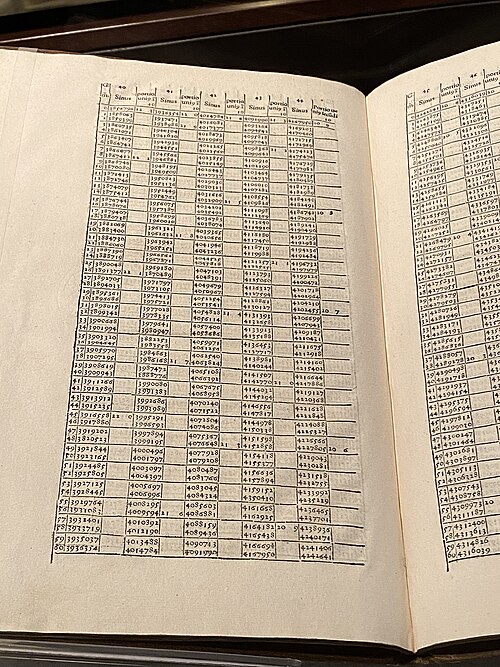

Computing these tables is useful work but doing it by hand is very slow and error prone. Perhaps we need some kind of automated computer to be able to calculate these automatically?
Computing Trigonometric Values
Charles Babbage wanted to build a machine to calculate polynomials which could generate trigonometric functions, among others. However his difference engine which was funded by the British government was quite expensive and was never completed as it took years to complete the parts that were done. The mechanical computer is always going to be expensive, very large and difficult to program so the digital electronic computer that developed during the 20th century was the holy grail for calculating trigonometric.
What is the computation that gets carried out though. For example if I
run the code console.log(Math.sin(1.234)); in this
website, what does it do to get the value of 0.9438? Note that the angle is in radians
there. The answer is actually not that interesting since we only need an
approximation to a certain degree. In the browser numbers have 64 bits
so there's a lot of approximations for different cases, using pi and
other constants. It's stored as a floating point numbers which are cool
but definitely a topic for a different post - this is important since
the layout of bits influences the algorithms being used. There are more
precise calculations of sine or other trigonometric functions for niche
usages but for most practical purposes you only need a few decimal
places.
Conclusion
It's cool to trace the history of how words, functions, concepts were derived to see their origins, both to give you a deeper understanding of the human drive that lead to it and to bolster your comprehension by looking at it from first principles. Trying to follow the thought processes of the people that came up with the ideas might mean you learn them slower but more thoroughly.
Really this is an encouragement to understand history to understand the present, which is a trite statement but what more can you expect.